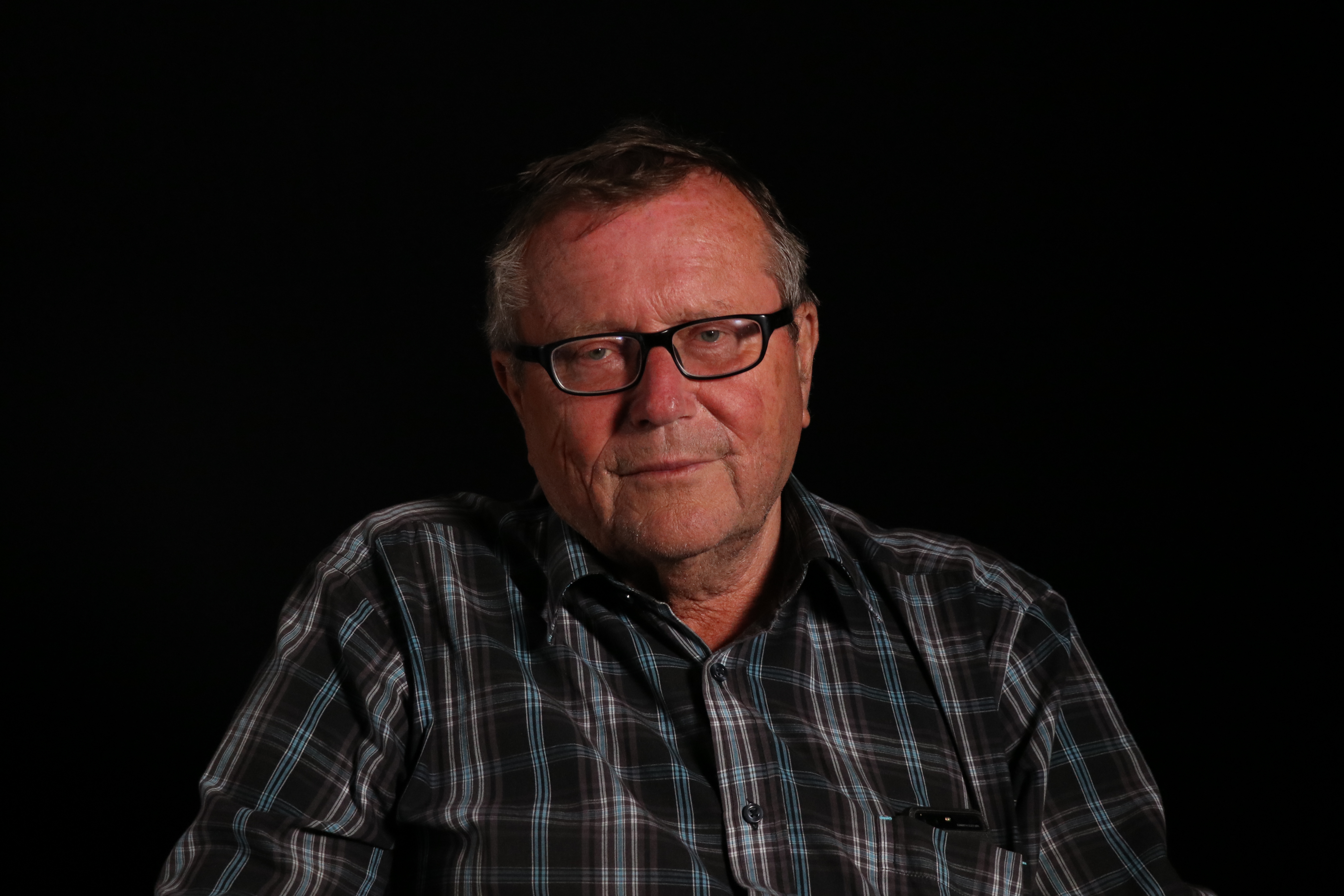
Josef Vomáčka

* 1945

  • "I was sitting at my workplace, I took over at seven thirty, we went by some... There were no plans, right, we had the national anthem and some music, some classical music, whether My Country or what, I don't know. And now there was talk, talk. Then at 7:35 they broke down the thick padded door that was there then, maybe it still is, that was the studios, the radio sation Praha. That was the best and the biggest studio, and besides that there was a station called Czechoslovakia, or Praha 2 in those days. That was easier, that was one floor up. There was no broadcasting from there in the morning, it was all on one channel. So they broke down the door and seven Russians with machine guns actually came in. Šťovíčková says there she doesn't know if we'll ever meet again. She was still in the newsroom and she saw through the big glass, the double glass that connects the workplace with the direction, so she saw that we already had the people there. I had to get up, I was sitting behind the raised counter and they could see a lot that I was the important one. He came around me from behind in a different way and stuck a machine gun with the spike like the spikes on the machine gun, he stuck it in my back. And now one of the Czechs came in, and it was strange enough, and I'm still thinking that it was Karel Hoffman, but he was no longer the director at that time, it was Zdeněk Hejzlar, but Hoffmann was hanging around like that and he told me to end it. I said to Mrs. Vondrušková: "Zuzanka, play the anthem."

  • "I went home and I knew I was to be in the radio at 7:30 in the morning, and I knew I shouldn't have gotten too drunk. I had like six beers, let's say, which I really felt. I got home at about one o'clock, I opened the windows - we lived on Fügner Square - I said to myself, I'm so drunk, I kept hearing planes buzzing, thinking that of course I was dreaming. Well, the planes were roaring, I didn't sleep well, it woke me up. Right over the rooftops the planes were roaring so much. Suddenly at about six, five thirty in the morning the bell rang. We somehow had a telephone or at one time we were allowed to have a telephone. The bell. Miloš Síkora came in, he's a painter who has been living in Paris for years, or emigrated at the turn of the regime, and he's an interesting person, he was a classmate of mine from eleven years old, from secondary school. And he said, 'Mrs. Vomáčková,' he woke my mother up, I was lying there sleepy, 'the Russians are here,' so my mother told him he was drunk, to go away. They turned on the radio and they heard all this stuff, so my mum said, "Pepíček, look, get up. Something's going on, the Russians are here and you're on duty.' She knew I was supposed to be in the radio at 7:30 in the morning, so I said, 'Hey, I'm going.' There were no mobile phones, nothing. She said, 'You don't have it until 7:30. I said, 'There's something going on, I have to go to the radio.' Síkora went with me.

  • "American films started to be shown. We used to go in the morning - we used to play truant to run to the cinemas. There was the French New Wave, there were the first American movies, rock 'n' roll started, we went to see Miki Volek, these bands. Actually, we cut out the Bolsheviks completely. So we grew up pretty fast, we read, and we all moved at about the same speed. The less I had in common with a Bolshevik. The '80s for us started in '60. We began to sense that opening river of information and, in fact, the growing pleasures and excitement of good literature. The little theaters started, all these things started here, so we grew up quite intellectually in proportion to that, fortunately. Really '68 was a natural outgrowth for us of the development of society."

  • Celé nahrávky
  • 1

    Praha, 06.06.2023

    (audio)
    délka: 02:00:28
    nahrávka pořízena v rámci projektu Stories of the 20th Century TV
  • 2

    Praha, 19.06.2023

    (audio)
    délka: 02:08:26
    nahrávka pořízena v rámci projektu Stories of the 20th Century TV
  • 3

    Praha, 04.09.2023

    (audio)
    délka: 02:06:20
    nahrávka pořízena v rámci projektu Stories of the 20th Century TV
Celé nahrávky jsou k dispozici pouze pro přihlášené uživatele.

The sixty-eighth year began for us in the year sixty

Josef Vomáčka, 2023
Josef Vomáčka, 2023
zdroj: Post Bellum

Josef Vomáčka was born on 17 July 1945 in Prague, in Karlova Street to Zdeňka and Josef Vomáček. He spent the first years of his life in Litvínov, where his family left to follow father´s job. From 1952 they lived again in Prague. In 1959, he entered secondary general education school (similar to today‘s grammar schools) in Prague‘s Vyšehrad district. In 1962, he was accepted to study architecture at the Czech Technical University, but he dropped out after the first term due to failing an exam in geology. For the next six months he worked as a concrete worker, after which he re-entered the faculty but failed to complete it. For a while he worked as a lighting technician in the film studios at Barrandov. In 1966, he joined Czechoslovak Radio, where he lived through the invasion of the Warsaw Pact troops - then as a broadcasting director. He was fired in 1969. Subsequently, he worked in the promotional department and then in sales at the Laktos dairy company. In 1981 he came under the radar of State Security (StB). In 1992 he found his name on the lists of secret State Security collaborators. In 1999, the Supreme Court ruled that he was unlawfully registered. After the Velvet Revolution, he worked as a film critic, curator of art and architecture exhibitions, and a guide for foreign tours. In 2023 he was living in Prague.